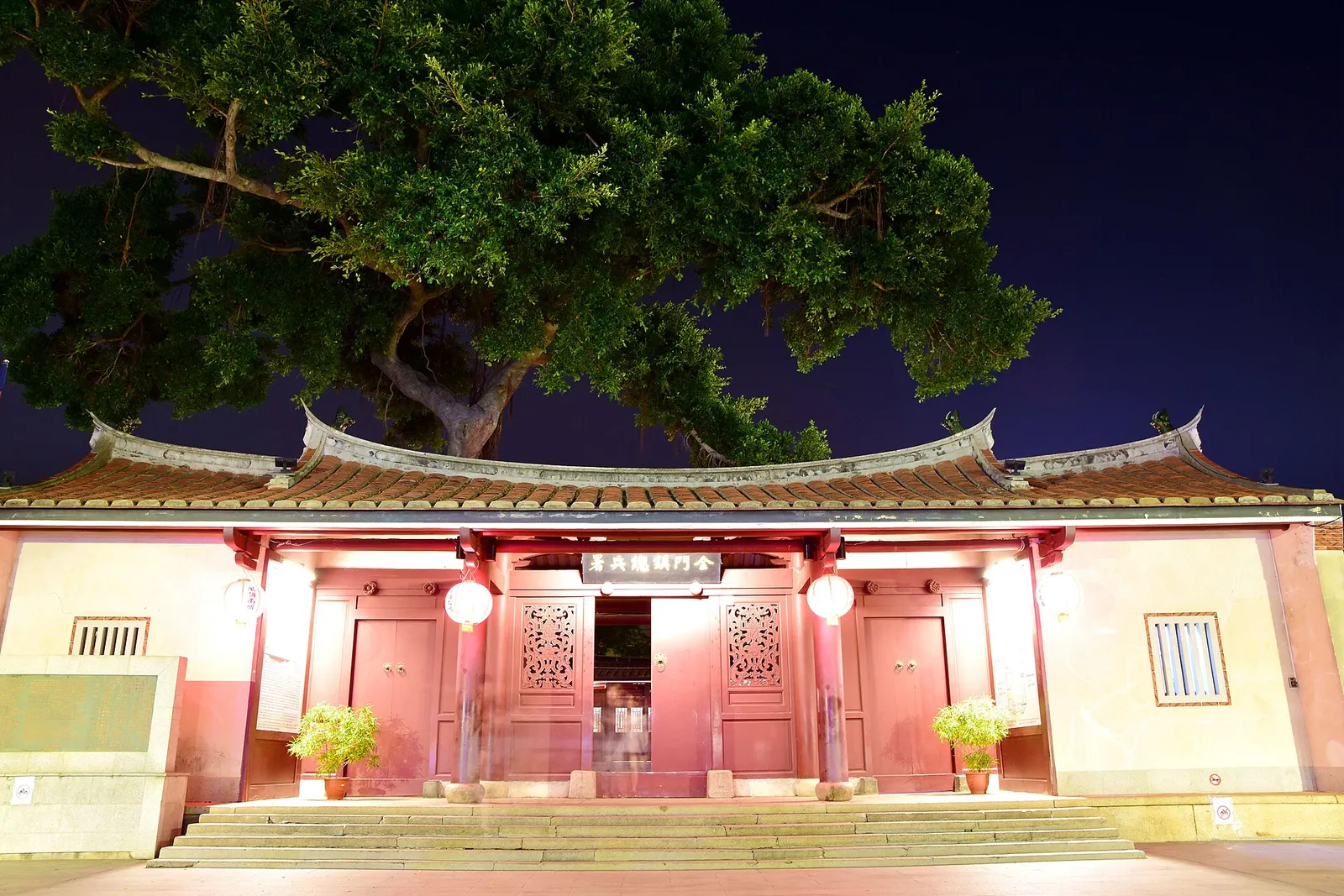
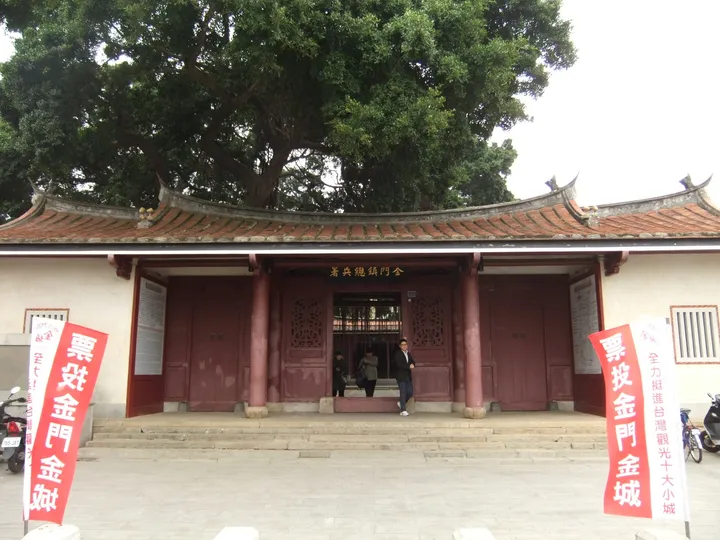
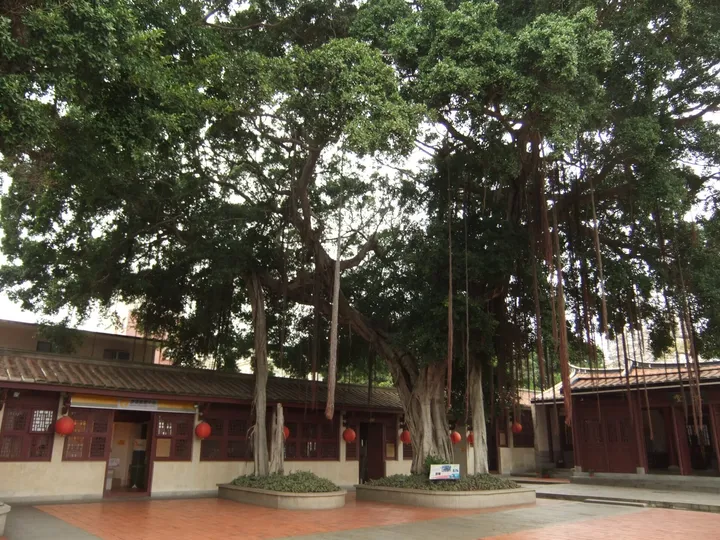
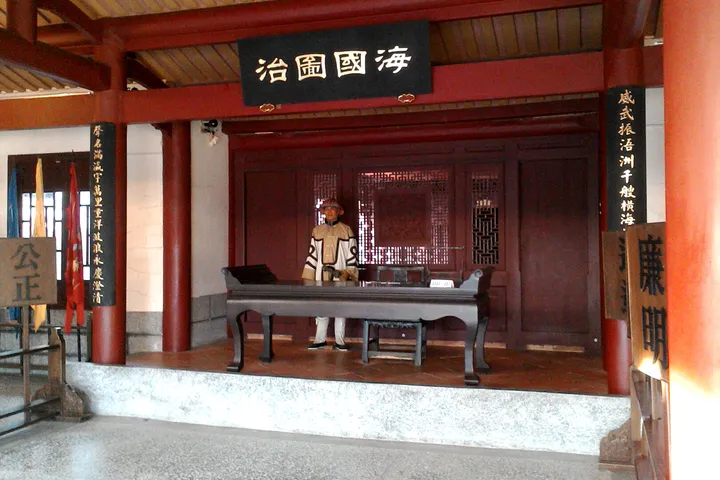
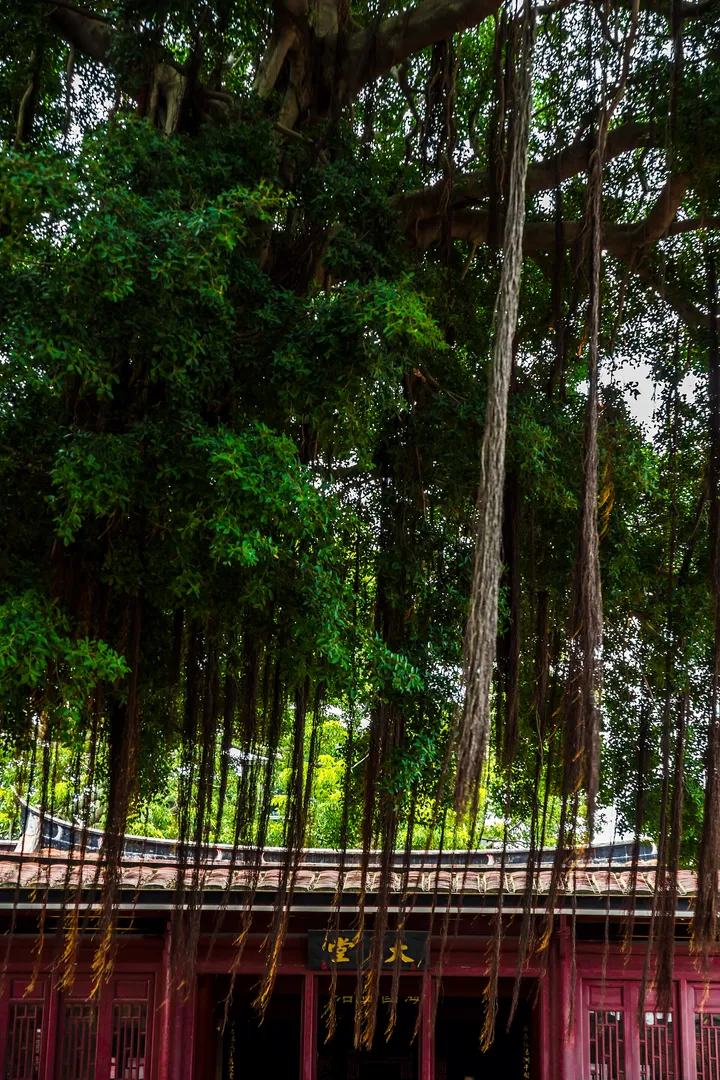
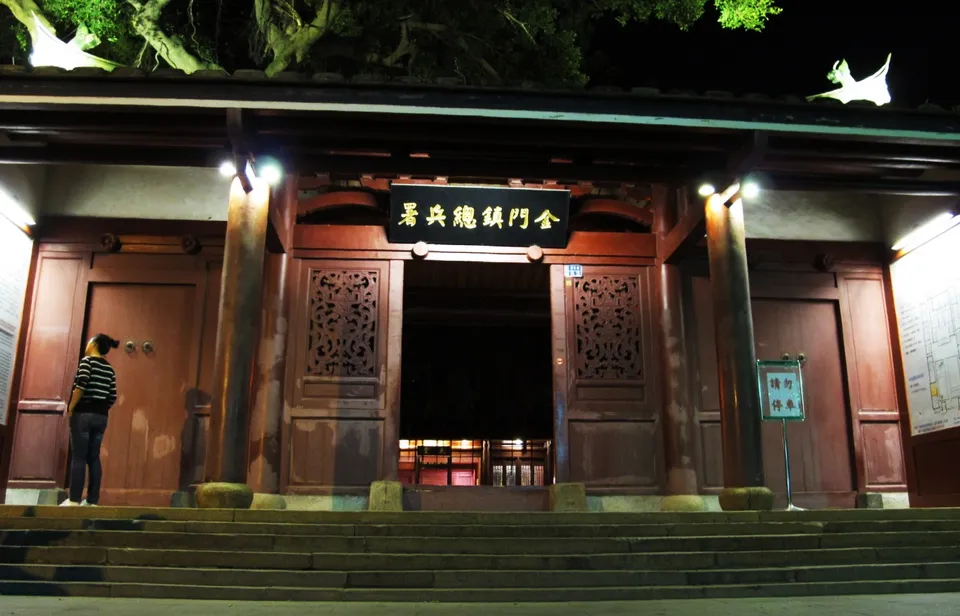
Kinmen Military Headquarters of the Qing Dynasty (Wujiang Xinzhuang) is the landmark Qing government compound in Jincheng Township, Kinmen County. Opening hours, free admission, an indoor map and the Houpu night tour — allow 30–60 minutes for a typical visit in central Jincheng.
Hours and activities may change because of maintenance, weather or events. Check current official notices before departure.
Live weather
Jincheng Houpu live weather and 7-day forecast
More than a temperature: temperature, feels-like, UV, wind and rain chance are turned straight into what to wear, how to plan and what to pack today.
Updated 23:29
Weather alerts
Strong wind
Winds are strong. Keep clear of signage, hoardings and coastal rocks; signs and branches may fall, and crosswinds make riding risky.
Today31–27°C
Feels like28°C
UVHigh
WindForce 5
Rain chance55%
Now
27°
Clear sky
Feels like
28°C
Humidity
82%
Wind
27 km/h
Rainfall
0.0 mm
A compact umbrella may help
Next 7 days
Today Overcast 55% 31° / 27°
Mon, 9/14 Overcast 50% 30° / 26°
Tue, 9/15 Mainly clear 0% 30° / 26°
Wed, 9/16 Overcast 0% 28° / 24°
Thu, 9/17 Overcast 4% 29° / 24°
Fri, 9/18 Overcast 11% 30° / 26°
Sat, 9/19 Clear sky 16% 30° / 26°
How to plan today
Strong wind risk today — keep the plan conservative
What to wear
Temperatures are comfortable — a long-sleeved top or light jacket is enough and easy to layer.
It is windy — wear a windproof jacket and fitted trousers, and skip loose skirts or hats that blow away.
What to plan
Houpu itself is a sheltered town walk, but the coast and Taiwu Mountain see far stronger wind and rain — stay away from surf zones, wet rocks and the summit in these conditions.
What to pack
A rain jacket rather than a long umbrella, which fails in strong wind
Sunscreen SPF30+, sun hat and sunglasses
Plenty of drinking water
Phone and power bank for flight checks, notices and emergencies
The site sits in central Jincheng/Houpu on a town walking route: rain, wind and feels-like temperature matter most, and there is almost no terrain risk. If you extend to the coast or Taiwu Mountain, apply stricter wind and rain thresholds and watch for surf zones and slippery rocks.
Forecasts are model estimates and coastal or hill wind is usually stronger than inland. During typhoons, dense fog or heavy rain, follow official warnings and airline or ferry notices.
Seasonal planning
Seasonal visiting strategy
The same site looks completely different through the year. The table lines up temperatures, rainfall patterns, seasonal highlights and what to wear, so you can pick a strategy straight from your travel month.
Four-season visiting strategy for the Kinmen Military Headquarters
Season
Temperature
Rain and weather pattern
Highlights
What to wear
Best for
Spring Mar–May
About 15–25°C, cool mornings and evenings
March–April is the island’s fog season, when sea fog can cut visibility fast. From May the Meiyu front brings short, intense downpours.
Kapok blossom, clear views of the historic courtyards, and northbound migratory birds passing through
Light long sleeves plus a windproof layer and a compact umbrella; a mask helps in fog season
Photography, village walks, birdwatching
Summer Jun–Aug
About 27–33°C, hot and humid
End of the Meiyu season and the typhoon period. Afternoon thunderstorms are frequent and UV levels are often very high.
The site stays open until 22:00 — ideal for evening walks and indoor exhibitions
Breathable light clothing, sun hat, rain gear and a water bottle
Indoor visits, night walks, heat-avoiding itineraries
Autumn Sep–Nov
About 22–30°C with a widening day–night gap
The most stable weather and best visibility of the year; from October the northeast monsoon builds week by week.
Deep blue skies against red-brick architecture; southbound migration begins and wintering waterbirds arrive
Light long sleeves plus a packable jacket for the evening
Photography, nature observation, long village walks
Winter Dec–Feb
About 10–18°C, but strong wind makes it feel colder
The northeast monsoon is at its strongest, especially near the coast and in open areas. Rain is scarce but overcast, chilly days are common.
Indoor exhibitions and evening lighting; fewer crowds make it easier to study architectural detail
Windproof insulated jacket, scarf and beanie; watch crosswinds when riding
Indoor guided tours, short visits, sheltered routes
Figures are regional averages compiled from 1991–2020 climate normals and local public data. Always check the live forecast and official warnings for actual conditions.
Climate
Kinmen has a subtropical monsoon climate: the annual mean is around 21°C, July–August averages close to 29°C, and January–February about 12–13°C. Annual rainfall of roughly 1,000–1,100 mm is markedly lower than mainland Taiwan and concentrates in April–August. From October to March the northeast monsoon keeps wind speeds high. Advection fog in March–April and typhoons in July–September are the two biggest threats to flights and ferries.
Water and tides
Kinmen has no large perennial rivers; supply depends on reservoirs and groundwater, and high evaporation makes the island water-sensitive, with occasional rationing in dry spells. Jincheng sits right on the coast, and the Houpu harbour and Wujiang Creek mouth are semidiurnal, with a tidal range of roughly 2–4 m. Storm surges and cloudbursts during typhoons can briefly flood low-lying roads, so keep itineraries flexible.
Ecology and seasonal wildlife
Kinmen sits on the East Asian migratory flyway and is an important stopover and wintering ground: cormorants and other wintering waterbirds from October to March, with a passage peak in April–May. The island bird, the hoopoe, can be seen year-round, while blue-tailed bee-eaters arrive to breed from May to August and are a favourite of photographers. In central Houpu the common birds are urban species such as tree sparrows, light-vented bulbuls and spotted doves, most active at dawn and dusk. Kapok and chinaberry trees in the courtyards mark the seasons with their flowering.
About Kinmen Military Headquarters of the Qing Dynasty
Kinmen Military Headquarters of the Qing Dynasty (Wujiang Xinzhuang) is the landmark Qing government compound in Jincheng Township, Kinmen County. It began as the Ming scholar Xu Xie’s residence, Congqing Xuan, and was rebuilt as a military headquarters by General Chen Long in 1682. Admission is free, and the site is the clearest starting point for understanding Kinmen’s coastal defence and the growth of Houpu.
Location & how to visit Kinmen Military Headquarters in Jincheng Township
The address is No. 53, Wujiang Street, Beimen Village, Jincheng Township, Kinmen County 893, Taiwan (Plus Code C8J9+W9). Jincheng Bus Station is about 195 metres away, a walk of roughly three minutes. Drivers and riders should park legally in central Jincheng and continue into the Houpu old town on foot.
地址
No. 53, Wujiang Street, Beimen Village, Jincheng Township, Kinmen County 893, Taiwan
When visiting Kinmen Military Headquarters of the Qing Dynasty, travellers can easily explore surrounding historical landmarks and points of interest on foot, including Mofan Street and Qiu Liang-gong’s Mother Chastity Arch.
History & significance of Kinmen Military Headquarters
From a Ming scholar’s residence and its 1682 conversion into an official compound, through its role as a Qing coastal defence centre, to today’s free heritage and exhibition site, the headquarters records how Houpu developed from a military administration into a market town.
Is it worth visiting?
A Qing government compound you can walk through
Best suited to
· Travellers interested in Kinmen history and coastal defence
· Visitors who enjoy historic architecture and cultural spaces
· Families or older visitors who prefer a compact, largely level route
· Independent travellers planning a half-day walk in Jincheng
May feel less rewarding for
· Visitors interested only in viral photo spots
· Anyone with no interest in history or exhibitions
· Travellers expecting a large interactive or multimedia attraction
Our recommendation
It is worth making time for, especially because Mofan Street, the City God Temple and Qiu Liang-gong’s memorial arch are nearby. It is the most useful starting point for exploring Houpu on foot and can lead into the 19:30 night tour.
Recommended general itineraries (half day / full day)
Both routes start at the headquarters: the half day covers one government compound plus one old street; the full day adds villages and battlefield sites near Jincheng. Times are relative suggestions — trim them to suit your energy and the weather.
Half day
Half-day essentials (about 3–4 hours)
About 45 minutes of walking in total
Centred on the headquarters and linked outward to Houpu old street and nearby monuments. Entirely walkable with no transport needed — ideal for your first or last half day on the island.
00:0020 min
1 Arrive at the main gate and front courtyard
Read the swallowtail ridges, brick walls and ceremonial gate first to get the overall layout.
00:2030 min
2 Main hall and side corridors
Understand the yamen-before-residence layout and where court was held.
00:5030 min
3 Rear garden, inner residence and indoor exhibitions
Air-conditioned rooms with seating — a good place to rest, refill water and use the toilets.
01:2040 min
4 Walk to Houpu old street (3–5 min)
Study the shop-house façades and arcades of the commercial street that has continued since the Qing era.
02:0025 min
5 Nearby arch and village node
Part of the same Qing-era Houpu fabric — compare the official and folk axes of the town.
02:2530 min
6 Street snacks or dessert (your choice of type)
Choose a place with indoor seating and dodge the midday sun.
Full day
Full-day deep route (about 6–8 hours)
About 20–30 minutes of travel between stops
Spend the morning in depth in Houpu, extend into the villages and military sites just outside Jincheng in the afternoon, then return for an evening walk. Suited to travellers who want to understand why Kinmen looks the way it does.
09:0060 min
1 Headquarters: courtyard, main hall, corridors
Quietest hour of the day, with the best light for photographs.
10:0045 min
2 Rear garden, inner residence and special exhibitions
Exhibitions rotate, so the theme varies by season.
10:4575 min
3 Houpu old street, arcades and arches
Chain these on foot to read the street pattern laid down since the Qing era.
12:0060 min
4 Lunch (choose by food type)
Old-street kitchens are fully open at midday, with plenty of vegetarian and noodle options.
13:3090 min
5 Villages and arcade-house architecture just outside Jincheng (about 10 min by car)
Compare the two architectural systems: Minnan courtyard houses and overseas-Chinese arcade mansions.
15:1590 min
6 Pick one coastal or tunnel military site
Most battlefield sites sit on the coast where it is windy — dress warmly and mind your footing.
17:1590 min
7 Return to Houpu, rest and dine
Head back to your lodging to reset, then eat out.
19:3090 min
8 Houpu evening walk and guided tour
The site stays open to 22:00, and the lighting at night shows a completely different face.
Transport and timing notes
Bus: Jincheng bus station is the main interchange, within a 3-minute walk.
Driving: the historic core is pedestrianised — park outside and walk in.
Scooters: bays are limited — never block residents’ entrances or fire lanes.
Times are suggestions only — adjust for opening conditions, weather and crowds.
Seeing a monument is not just about having been there — it helps to know what problems it was built to solve. Below is the layout, craft and conservation thinking, followed by the responsibilities every visitor can meet.
Architecture and heritage science
Yamen in front, residence behind
Qing local government compounds generally followed a “office in front, residence behind” plan: the front held the main gate, ceremonial gate, main hall and clerks’ rooms for administration and hearings, while the rear was the private quarters of the official and family. The layout served both administrative efficiency and social order — outsiders stopped at the main hall. Once you can read that axis, the room arrangement of the whole complex makes sense.
Minnan building craft: red brick, granite, timber
Traditional official compounds and houses in Kinmen share one Minnan vocabulary: granite blocks for wall bases and door frames, red brick walls with patterned joints, and hybrid post-and-lintel timber frames. The upswept ridge ends (swallowtail ridges) are more than a symbol — they shed rainwater and reduce wind load — while decorative tilework and painting marked the building’s rank.
Building for an island climate
Kinmen’s fierce winter monsoon and salt-laden air shaped a low, thick-walled architecture on raised plinths with deep eaves: heavy walls and narrow openings cut heat gain and wind load, the raised base keeps damp out, and the deep eaves and corridors create shaded, rain-sheltered transition space. Most of this was negotiated with wind, salt and humidity long before it was about beauty.
Heritage conservation: repair, not remake
Conservation follows minimal intervention and reversibility: components that can be repaired are not replaced wholesale, and new reinforcement must remain identifiable, so traces of different eras survive. That is why you will see bricks of slightly different tones, spliced timber or fresher paint — not sloppy work, but conservation ethics made visible.
Adaptive reuse: from government office to museum
Preservation is not only about not demolishing; it means finding a contemporary use. Turning a Qing government office into an exhibition and tourism site requires balancing public access, artefact protection and structural load — crowd management, climate control in display rooms, circulation and fire evacuation are all new professional problems introduced by reuse.
Visitor responsibilities
Protecting the artefacts
Do not touch, lean on or climb artefacts or building components. No food or drinks in display rooms, and no flash or selfie sticks — light and impact cause irreversible damage.
Heritage etiquette
Keep your voice down, do not run, yield to guided groups and check that your photos are not blocking sightlines or passageways.
Environmental responsibility
Take your litter with you and sort it properly. Fresh water is scarce on the island, so use it sparingly, and never feed or chase wildlife or birds.
Safety
Watch for thresholds and level changes; stone floors get slippery after rain, so slow down. During typhoons, dense fog or strong wind, follow staff instructions and stay away from the coast and open ground.
Children, elders and pets
Children should stay with an adult and avoid running in the corridors. Older visitors and those with limited mobility should use the main, level route. Except for assistance dogs, pets are not allowed in indoor display rooms.
In an emergency
Note where the nearest exits are. Report accidents or feeling unwell to staff immediately. Emergency numbers: 119 (fire and ambulance), 110 (police), 112 (from a mobile phone).
Register on site for the free 19:30 guided walk. It leaves from the headquarters area and continues through academies, ancestral halls, temples, Western-style houses and memorial arches before finishing on Mofan Street.
The same monument reads differently depending on whether you are with children, carrying a camera or limiting how far you walk. These three plans are built around group composition and pace, and pair with the half-day and full-day routes.
Families with children
Family plan
Duration
About 50–70 minutes, easily split in two
Best time
09:30–11:30 or 16:30–18:00
1Enter the front courtyard and count the swallowtail roof ridges — a quick game that gets children looking up.
2Pass through the ceremonial gate into the main hall where officials once held court.
3Rest in the rear garden, refill water and use the toilets.
4Finish with a snack on Houpu old street, linking the monument to daily life.
Look for Roof ornaments, stone carvings and timber details, and the sense of courtyard space — use treasure-hunt prompts to keep children observing.
Keep in mind
There are thresholds and steps; use the side ramps or ask a companion to help with a stroller.
No running or touching exhibits indoors, and keep voices low.
In summer avoid midday heat and keep everyone hydrated.
Photography and nature
Photography and nature plan
Duration
About 90–120 minutes including the old street
Best time
Early morning 07:00–09:00 or pre-sunset 16:00–18:00 for softer light
1Walk the perimeter first to read the façade proportions and the Houpu roofline, then choose your main angle.
2Shoot the main hall head-on from the centre of the courtyard for symmetry, avoiding crowds and umbrellas.
3Side corridors and corners suit timber, stone and light-and-shadow details — a longer lens compresses the layers.
4After dark (18:00 onwards) the lighting comes on for night shots and the old street’s lantern strings.
Look for Swallowtail ridge silhouettes, the texture of red brick and granite, and the geometry of lintels and lattice windows — air clarity peaks in autumn and winter.
Keep in mind
Flashes and tripods are usually banned indoors — check the notices first.
Do not block the main route for long; yield when tour groups arrive.
Drone use is restricted by law and by the nearby airport — check the rules before flying.
Low mobility and accessibility
Low-mobility and accessible plan
Duration
About 30–40 minutes, with rest stops as needed
Best time
Weekday mornings are quietest; late afternoon is cooler
1Use the main entrance to avoid side steps; a companion should help wheelchairs and walkers over the thresholds.
2Keep to the edge of the corridors; benches are distributed around the courtyards.
3Focus on the main hall and a single exhibition room rather than covering everything.
4Finish at a nearby indoor café or restaurant with seating to avoid standing for long.
Look for The scale of the main hall, its plaques and furniture — everything is readable from a seated eye level.
Keep in mind
Stone and brick floors become slippery after rain — wear non-slip shoes and slow down.
The accessible toilet sits beside the main toilets and closes with the site at night.
Ask at the service desk about alternative routes and assistance.
Arriving from Jincheng Station, the airport or Shuitou Pier
Jincheng Bus Station is about 195 metres away, normally a three-minute walk. The transport guide also covers the airport, ferry terminal, driving and parking.
The information below is organised by facility type and covers what visitors ask about most: toilets, drinking water, parking, food, lodging, shops, fuel and charging, luggage and connectivity, medical care and accessibility. It describes categories only — no specific business is recommended or ranked.
Toilets and accessible WCs
Public toilets inside the heritage compound, including an accessible one
Jincheng bus station, visitor service centres, convenience stores
Restaurants and shopping arcades with public facilities
On-site toilets follow the 09:00–22:00 opening hours; late at night use a convenience store or the bus station.
Drinking water and rest
Water dispensers in the compound and public buildings
Seating along the corridors, courtyards and shade trees
Rest areas in the bus station, library and other public buildings
Summers are hot and humid — carry a bottle and drink hourly. Winter brings a strong northeast monsoon, so keep a windproof layer for the courtyards.
Parking and transfers
On-street metered car spaces
Public surface or multi-storey car parks, a 3–10 minute walk away
Scooter bays and coach drop-off areas
Bus routes and taxi ranks
The historic core is pedestrianised and closed to vehicles. Spaces fill up on weekends and public holidays — park on the edge of town and walk in.
Where to eat
Chinese breakfast types: congee, savoury rice porridge, flatbread with fried dough
Noodle shops, oyster omelette and fried snack stalls
Kinmen-style shared-plate restaurants and seafood dining
Vegetarian kitchens, tofu-pudding dessert, shaved ice and tea shops
Convenience-store light meals and supermarket deli counters
Most places are small family businesses open around midday and early evening, with a weekly rest day. We describe categories only and never endorse a particular shop.
Where to stay
Minnan courtyard homestays in restored traditional houses
Western-style arcade houses and modern homestays
Business hotels and tourist hotels
Hostels and backpacker dorm beds
Small-scale homestays dominate, many inside historic villages with only a few rooms. Book weeks ahead for peak season (April–June, October) and long weekends.
Convenience stores and supermarkets
Chain convenience stores, many open 24 hours
Local and fresh-produce supermarkets
Souvenir shops for peanut brittle, thin noodles and kaoliang liquor
Pharmacies and household hardware stores
Shops inside the old street are small; larger supermarkets sit along the main roads out of town.
Editorial neutrality This is a non-profit educational site. It describes facility and service categories and general wayfinding only, and does not recommend, rank, endorse or sell on behalf of any specific business or brand. Hours, prices, stock and service details change — always check on-site notices and official information.
Frequently asked questions
Check these before departure
How long does a visit take?+
Most visitors need 30–60 minutes. Use the 20-minute route if you are short on time.
Is there an admission fee?+
No. Admission is free.
What are the opening hours?+
The published hours are 09:00–22:00 daily. Temporary changes may apply.
Can I visit in the evening?+
Yes. The site is normally open until 22:00 and can be combined with the 19:30 Houpu walk.
Is it suitable for children and older visitors?+
The route is compact and largely level, although historic thresholds require care.
Is it worth visiting when it rains?+
Many displays are inside halls or along covered corridors, making it a practical rainy-day stop.
May I take photographs?+
Photography is generally allowed in visitor areas. Follow on-site signs and do not touch exhibits.
How do I reach Mofan Street?+
It is only a few minutes away on foot and combines easily with the memorial arch and Wujiang Academy.
Sources & verification
Where this information comes from
This page is an independent visitor guide. Facts that affect a visit are checked against the sources below and dated.